The One-Page Decision Paper That Gets a Yes
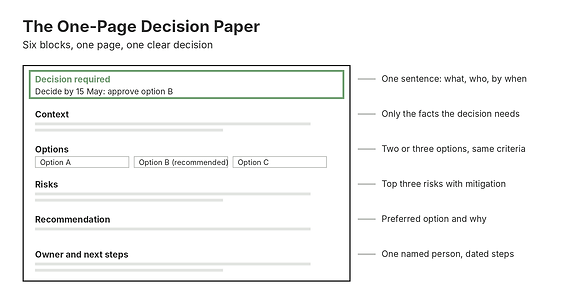
61% of managers say most decision time is used ineffectively. A one-page decision paper puts the ask first and gets a clear answer faster.

Alexander Kiel
Business Analyst · Banking & Wealth Management
30.04.2025 · 6 MIN READ · PMO SUPPORT
ON THIS PAGE
1. Start With the Decision
2. Give Only the Context Needed
3. Show the Options
4. Make the Risks Visible
5. Name the Owner and Next Steps
6. Send the Decision Paper Early
Sample case: Procter & Gamble
In short
FAQ
Managers spend a large part of their week on decisions. Much of that time is lost. In a McKinsey survey of 1,228 managers, respondents spent 37% of their time making decisions. 61% said most of that time was used ineffectively. Only 20% said their organisations excel at decision making. A one-page decision paper is one of the simplest ways to win some of it back.
For an average Fortune 500 company, McKinsey estimates the cost at more than 530,000 days of lost working time and roughly $250 million of wasted labour costs per year. Supervisors see the same problem in banks. In its 2024 draft guide on governance, the ECB expects management bodies to receive clear and concise documentation, enabling meaningful discussions, shared well before the meeting.
A steering committee can only decide what it understands. Would your last decision paper still make sense to a reader who had only five minutes?
STEP 1
Start With the Decision
Put the decision you need in the first sentence. Name what should be decided, by whom and by when. Readers who stop after one line should still know what is asked of them.
Experienced writers call this putting the bottom line up front. Former P&G Global Marketing Officer Jim Stengel described the P&G memo as opening with the desired outcome before the background, followed by objectives and strategy.
✓
State the decision required in one sentence
✓
Name the decision body and the deadline
✓
Give the recommended option in the same paragraph
Can someone tell what you want after reading only the first two lines?
Keep in mind: "For information" papers that hide a decision cause confusion. If you need an approval, say so in the first line.
STEP 2
Give Only the Context Needed
Background is there to support the decision, not to show how much work was done. Include only the facts the committee needs to judge the options: the problem, its cause, its cost and why a decision is needed now.
Winston Churchill made the same point to his War Cabinet in 1940, writing that official papers are too long and too diffuse. Detail belongs in an appendix, where readers can find it if they need it.
✓
Describe the problem in two or three sentences
✓
Quantify the cost or risk of doing nothing
✓
Move analysis and data to an appendix
Which paragraph in your last paper could have been deleted without losing anything?
Keep in mind: Every sentence of history pushes the decision further down the page. Start where the committee needs to start.
STEP 3
Show the Options
A paper with only one option is a request for approval, not a decision. Show two or three real options, including doing nothing. Compare them on the same criteria: cost, benefit, time, risk and impact on clients. Where outcomes are not clearly defined, I have learned to get them written down and agreed first, which avoids unpleasant surprises later.
Kahneman, Lovallo and Sibony include the question "Have credible alternatives been considered?" in their checklist for reviewing major decisions. A clear comparison also shows the committee that the recommendation was tested against something.
✓
Present two or three options, including "do nothing"
✓
Compare all options on the same criteria in one table
✓
Mark the recommended option and explain why in one sentence
Would the committee see why your recommendation beats the alternatives?
Keep in mind: A weak alternative added only for contrast is quickly spotted. Present options you would be prepared to carry out.
STEP 4
Make the Risks Visible
Committees approve what they think they understand. Name the main risks of the recommended option, their likelihood and impact and how they will be managed. Include dependencies on other projects, systems or decisions.
The ECB draft guide expects board documentation to highlight risks and benefits of items on which decisions are expected. Risks that appear for the first time after approval damage trust in every paper that follows.
✓
List the top three risks of the recommended option
✓
State the mitigation and the owner for each risk
✓
Name dependencies that could delay the decision or its results
What is the one risk the committee would want to know about before saying yes?
Keep in mind: Hiding a risk to secure approval only moves the discussion to a worse moment. Show it now, with a plan.
STEP 5
Name the Owner and Next Steps
A decision without an owner is an opinion. End the paper with who will do what, by when and how progress will be reported. This turns the approval into action on the day it is given.
The P&G memo format also ends with next steps. Clear roles avoid the situation where everyone agrees and no one acts. My article on keeping a decision log everyone trusts shows how to record who owns each decision. Ask the committee to confirm the owner as part of the decision.
✓
Name one accountable owner for the decision
✓
List the next three steps with dates
✓
Agree when and how the committee will see results
Who will report back to the committee on this decision and by when?
Keep in mind: "The project team" is not an owner. Name a person.
STEP 6
Send the Decision Paper Early
A decision paper works best when it is read before or at the start of the meeting, not presented slide by slide. The ECB draft guide cites as good practice a policy of sharing documents at least five working days in advance. Amazon goes further: meetings start with everyone silently reading the memo in a kind of "study hall", as Jeff Bezos described in his 2017 shareholder letter.
Use the meeting time for questions and the decision itself. If the paper needs a long presentation to be understood, it is not ready. My article on the integration readiness check shows the format applied to a go or no-go decision.
✓
Send the paper with the agenda, not in the meeting
✓
Open the meeting with questions, not a presentation
✓
Record the decision, conditions and dissenting views in the minutes
How much of your last steering committee was spent presenting rather than deciding?
Keep in mind: A paper sent the night before is often not read. Plan the writing backwards from the committee date.
How to Speak | Patrick Winston (Professor @ MIT)
SAMPLE CASE
Procter & Gamble
Procter & Gamble is known for its one-page memo, a format that has shaped the company's internal communication for decades. According to Tom Peters, the tradition goes back to Richard Deupree, P&G president from 1930 to 1948, who disliked memos longer than one typed page. He often returned long ones with the note "Boil it down to something I can grasp".
Deupree saw it as part of his job "to train people to break down an involved question into a series of simple matters". The format that grew from this follows a fixed sequence. In the version described by author Charles Decker, it runs from purpose and background to recommendation, rationale, discussion and next steps, with supporting exhibits attached.
Decker wrote that anyone who can write a P&G memo can learn how to think. Jim Stengel, later Global Marketing Officer, said the structure still shapes how he thinks.
Key takeaway: P&G did not treat the one-page limit as a rule on length. It used it to force clear thinking: one purpose, the facts that matter and a recommendation the reader can act on.
"Let us not shrink from using the short expressive phrase, even if it is conversational."
Winston Churchill (Prime Minister of the United Kingdom, Brevity memo of 1940)
In Short
A one-page decision paper is harder to write than a long one. It forces the author to know what is being asked, why it matters and what happens next.
Steering committees that receive short, decision-ready papers in good time spend their meetings deciding rather than reading. The result is faster decisions, clearer ownership and fewer topics that return to the agenda month after month.
Frequently Asked Questions
What should a one-page decision paper contain?
A good decision paper contains six elements: the decision required, the context needed to understand it, two or three options compared on the same criteria, the main risks, the recommended option and the owner with next steps. Everything else, such as detailed analysis and data, belongs in an appendix that readers can consult if needed. The first sentence always states the decision.
What if the topic is too complex for one page?
Complexity is a reason for a shorter paper, not a longer one. Summarise the decision on one page and move the analysis into appendices. If the topic still does not fit, it may contain several decisions that should be split into separate papers. A committee can always ask for more detail. A long paper often hides what is being decided.
How far in advance should a decision paper be sent?
Early enough for members to read it and prepare questions. The ECB draft guide on governance cites as good practice a policy of sharing documents at least five working days in advance. For internal steering committees, agree one fixed deadline and apply it to every paper. Papers sent the evening before are rarely read properly and often lead to postponed decisions.
TAGS
ABOUT THE AUTHOR
Alexander Kiel
Business Analyst for process optimisation, data migration, business integration and project support in banking and wealth management. Lean Six Sigma Green Belt and Certified Scrum Master. Former private banking front office, with front-to-back experience from client advisory to data and systems.
KEEP READING
Related Articles

PMO SUPPORT
3 OCT 2026 · 8 MIN READ
Close a Project and Keep the Lessons
How banks close a project properly: confirm the closure criteria, hand over open items, close access and budgets, write the closure report and turn lessons into real changes.

PMO SUPPORT
11 JUL 2026 · 8 MIN READ
RAG Status Reports That Show the Real Status
How to make RAG reporting show the real status of a bank programme: define each colour, rate against the baseline, back it with evidence, show the trend and escalate red with a decision.

PMO SUPPORT
29 MAY 2025 · 7 MIN READ
Keep a Decision Log Everyone Trusts
Bain found a 95% correlation between strong decisions and results. A decision log keeps each decision, its reason and its owner on record.