Create More Touchpoints With Less Expense
Touchpoints are the moments when buyers interact with your brand, whether it's through your website, email, phone calls, social media, demos or other forms of outreach.
The frequency of your touchpoints depends on factors such as your sales cycle, buyer persona, value proposition and response rate. There's no one-size-fits-all formula for how often you should touch prospects, but evidence shows that response rates tend to increase with each touch. Statistically, this number is around eight touchpoints, spread over 2 to 4 weeks, depending on the complexity and urgency of your offer.
So, how can you create more meaningful connections with your audience without spending more?
Increasing the number of touchpoints without increasing your marketing budget can be challenging, but you can address this by maximising your current resources, improving efficiency and leveraging partnerships.
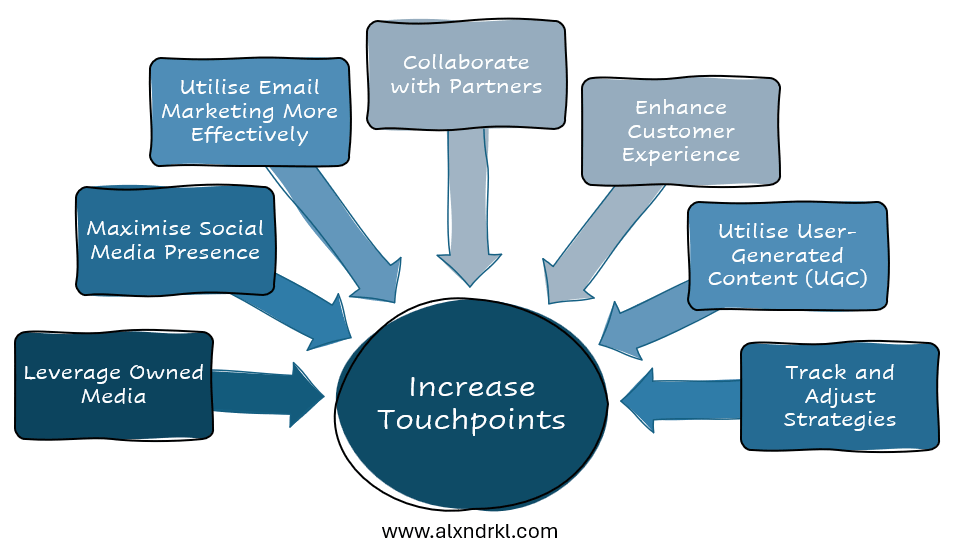
1. Leverage Owned Media
You can repurpose existing content into different formats, such as turning blog posts into social media snippets, infographics, or short videos. This strategy helps you reach audiences across various channels without creating new content from scratch.
Additionally, enhancing your website by adding features like a blog, FAQs, or interactive tools can boost repeat visits. Repeat visitors tend to add 65% more items to their carts, convert 74% more, and spend 16% more per transaction compared to first-time visitors, making website optimisation a key factor in driving more engagement and sales.
Audit existing content to identify high-performing pieces for repurposing
Transform content into multiple formats such as videos, infographics, or social posts
Enhance website functionality with interactive tools, FAQs, or blogs to increase engagement and repeat visits
Which existing content has the most potential for repurposing into new formats?
Example: An e-commerce brand turns its top blog posts into tutorial videos and shareable infographics. It also adds a product recommendation tool, driving more repeat visits and higher conversions.
2. Maximise Social Media Presence
You can share the same content across multiple platforms by adjusting the format or tone slightly to match each platform’s style, saving time while ensuring your message reaches different audiences.
Moreover, regularly engaging with your followers by responding to comments, messages, and mentions helps build stronger relationships and encourages word-of-mouth promotion, which boosts your brand’s visibility.
Schedule and share content consistently across multiple channels to maintain presence
Actively engage with followers by responding to comments, messages, and mentions to strengthen relationships
Which social media platforms do your target audiences frequent, and how can you tailor your content to fit each platform effectively?
Example: A lifestyle brand transforms a blog post into an Instagram carousel, a TikTok video and a newsletter snippet. By actively engaging with the audience, it boosts both engagement and brand awareness.
"You can't buy engagment. You have to build engagement" - Tara-Nicholle Kirke
3. Utilise Email Marketing More Effectively
Segment your email list and personalise your messages based on customer behaviour and preferences. Tailoring your content can significantly increase engagement and make each touchpoint more impactful.
Further, setting up automated email sequences for common customer actions, such as sign-ups, purchases or abandoned carts, will help you maintain consistent communications without requiring additional effort on your part.
Segment your email list to deliver personalised content tailored to customer behaviour and preferences
Implement automated email sequences for key customer actions like sign-ups, purchases, or abandoned carts
Analyse email performance metrics to refine messaging, timing, and targeting for better engagement
How can you automate email sequences to address common customer behaviors while still keeping the content relevant and engaging?
Example: An online retailer sends personalised product recommendations based on past purchases and automates follow-up emails for abandoned carts. By tracking open and click-through rates, they optimise campaigns, resulting in higher conversions and improved customer retention.
4. Collaborate with Partners
Boost your marketing efforts by partnering with complementary companies for joint promotions through co-marketing initiatives. This can be as simple as cross-promoting each other's products in newsletters or on social media, or more involved, such as hosting joint webinars.
Also, consider working with micro-influencers who may be open to working with you in exchange for products or services rather than cash compensation. These influencers often have niche audiences with higher engagement rates, which can help you increase touchpoints efficiently and effectively.
Identify complementary companies for co-marketing initiatives, such as joint promotions or webinars
Cross-promote products or services through newsletters, social media, or other shared channels
Collaborate with micro-influencers to reach niche audiences and boost engagement without large budgets
What types of complementary businesses could you partner with to create mutually beneficial co-marketing initiatives?
Example: A health food brand partners with a fitness studio to co-host a webinar and cross-promote on social media. It also engages micro-influencers to share reviews, increasing brand visibility and customer interaction.
5. Enhance Customer Experience
Encourage satisfied customers to refer their friends and family by implementing referral programmes that offer incentives such as discounts or rewards. Word-of-mouth referrals are a powerful tool for growing your touchpoints organically.
Similarly, consider establishing loyalty programmes that reward repeat customers with exclusive offers or early access to new products. A well-structured loyalty programme can significantly improve customer retention and encourage greater interaction with your brand.
Implement referral programmes with incentives such as discounts, rewards, or exclusive offers to encourage sharing
Develop loyalty programmes that reward repeat customers and strengthen their connection to your brand
Monitor and personalise experiences to enhance satisfaction and foster long-term engagement
How can you design a loyalty program that not only rewards repeat customers but also deepens their connection with your brand?
Example: A boutique coffee brand offers discounts for referrals and a loyalty card that provides free drinks after a set number of purchases, leading to increased customer retention and organic growth through word-of-mouth.
“The best advertising you can have is a loyal customer spreading the word about how incredible your business is.” – Shep Hyken
6. Utilise User-Generated Content (UGC)
Encourage customers to share their experiences on social media or review sites, and highlight these reviews on your channels to build trust and increase touchpoints.
Furthermore, consider hosting social media contests that prompt users to create and share content related to your brand. This strategy not only boosts engagement but also expands your brand’s reach by tapping into users' networks, exposing your business to a broader audience.
Showcase customer reviews and social posts on your own channels to build credibility and trust
Host contests or campaigns that motivate users to create and share content related to your brand
Encourage authentic storytelling by making participation easy and rewarding for customers
How can you effectively encourage customers to share their experiences in a way that feels authentic and engaging?
Example: A bank invites customers to share stories of how its mobile app helped them manage their finances using a branded hashtag. The most compelling stories are featured on social media and the website, with participants rewarded through small cashback incentives, boosting engagement and trust in the brand.
7. Track and Adjust Strategies
Use free tools like Google Analytics and Social Media Insights to track which strategies are working best for you. Refocusing your efforts on high-performing channels can maximise your impact without incurring additional costs.
Also, consider implementing A/B testing to experiment with different versions of your content or campaigns on a small scale. This approach can help you identify what resonates most with your audience and refine your strategy without wasting valuable resources.
Monitor key performance metrics using analytics tools to identify high-performing strategies
Conduct A/B testing on content or campaigns to determine what resonates best with your audience
Adjust strategies based on insights to optimise impact and resource allocation
What specific metrics will you focus on when using analytics tools to measure the success of your marketing strategies?
Example: An online retailer tests two versions of its email newsletter - one highlighting discounts, the other featuring new arrivals - using A/B testing, then focuses on the version with higher click-through rates, leading to improved engagement and sales.
Meaningful Micro-Engagements (Jeannie Walters, CEO @ Experience Investigators)
Sample Case: Sports Retailer Touchpoint Optimisation
A large Austrian sports appeal and equipment retailer sought to improve engagement and sales without increasing marketing spend. They recognised that simply adding more touchpoints wasn’t sustainable and instead needed to identify which existing interactions mattered most to buyers.
Using a conversion rate optimisation framework, the retailer analysed online and offline customer interactions to identify the most sales‑influencing brand‑owned touchpoints, such as website product detail views, loyalty programme emails and in‑store promotions. This helped them map the real customer journey instead of relying on assumptions about what mattered.
They then focused marketing actions on these key touchpoints - for example, retargeted email sequences for high‑interest products, personalised offers via loyalty programmes and coordinated timing with in‑store displays - rather than dispersing effort evenly across all interactions.
As a result, the optimisation framework helped the retailer increase sales impact from touchpoints deemed most influential and make better strategic decisions about resource allocation, boosting conversion efficiency without additional marketing cost.
Key takeaway: The retailer did not simply add more touchpoints. By identifying and focussing on the most impactful interactions that influence purchasing decisions, they maximised customer engagement and conversion on a budget.
“Your brand is a story unfolding across all customer touch points.” - Jonah Sachs
How will you turn existing resources into powerful tools for engaging with your customers more effectively?
Remember, while increasing touchpoints is crucial, quality always trumps quantity. It's not just about reaching out more often, but about making each interaction meaningful and relevant to your audience. Focus on understanding your customers' needs and preferences and tailor your messaging accordingly. A well-crafted touchpoint can do more for your brand than several generic ones.
Stay consistent, stay authentic and always put your customer at the center of your strategy. The more value you provide in each interaction, the stronger your relationships will become and the more successful your outreach efforts will be.


